- 1–11 THzcontinuous tuning
- 14 µWat 6–11 THz
The terahertz gap is the band of the electromagnetic spectrum that lies exactly between what electronic and optical sources can reach. Building sources for this range is extremely challenging. Lynkeas makes the first continuous, fully tunable, room-temperature THz source for 2–15 THz. Scroll down to see how we do it and what THz radiation can be used for.
We use difference frequency generation between two mid-infrared pump lasers on a thin semiconductor metasurface to generate THz radiation, tunable by simply tuning the lasers. This patented DFG metasurface can be produced in a scalable semiconductor fabrication process.
Click each component below to see its role in THz generation.
Two mid-IR lasers at frequencies f₁ and f₂ are combined and fed into the metasurface. Via difference-frequency generation, THz radiation (fTHz) emerges at exactly |f₁ − f₂|.
Precise control of the pump lasers directly defines the THz output. This is the foundation for tunable, selective spectroscopy.
The system uses commercial off-the-shelf optics (lenses, parabolic mirrors, and filters) for focusing/ re-directing beams and filter out unwanted frequencies.
Our patented metasurface, built using scalable semiconductor process, consists of nanometer-thin layers forming a multi-quantum well (MQW). The nonlinear interaction of incoming mid-IR light generates THz inside this MQW. Nanoscale resonators patterned into the surface boost both pump coupling and THz emission efficiency.

THz frequency, linewidth, and power is inherited directly from the mid-IR pump lasers. Because laser technology is mature, we deliver CW or pulsed emission, narrow linewidth, full tunability, and high output, all tailored per application.
Many molecules in the gas phase absorb terahertz radiation only at a characteristic set of frequencies. These are fundamentally determined by the molecule’s moment of inertia, which encodes the entire mass distribution and is sensitive even to small changes such as isotopic substitution. The THz absorption pattern is therefore as unique to each molecule as a human fingerprint, allowing for unambiguous chemical identification.
In the THz region, absorption lines are fundamentally narrower than in the neighboring infrared spectral region.
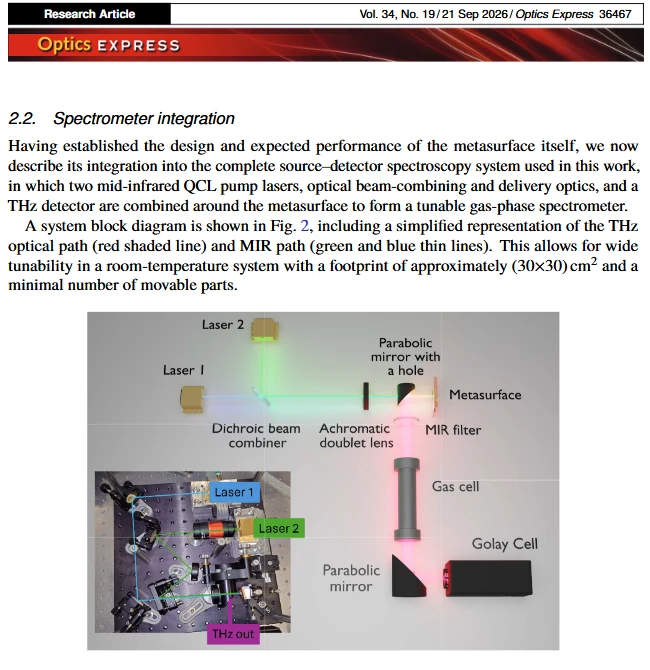

Using our metasurface with tunability between 5-11 THz, the very first low pressure gas spectroscopy line was measured at ISMO, Paris.

Chemical ID demonstrated on a portable 30×30 cm bench-top system at room temperature.

Our first product offering in the form of a research device; a continuously tunable, room-temperature CW terahertz source covering 2–15 THz.
The MVP 1.0 combines our THz source with a gas-cell enabling gas sensing. It was successfully used in a proof-of-concept campaign with Fraunhofer ICT. The design is modular by choice and it currently serves as our demonstrator.